.png)
Texas A&M Apartments on a TAMU Bus Route: Which Routes Actually Run to Class

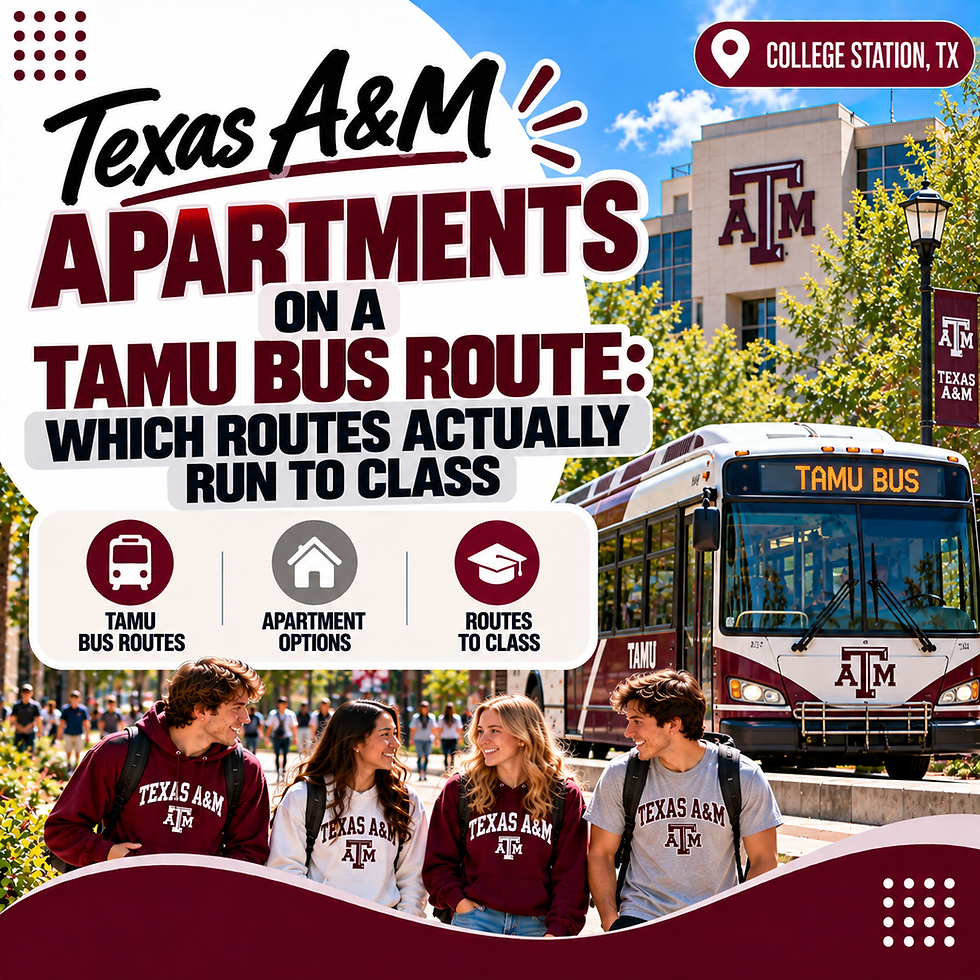
Ask any group of students in College Station how they get to campus and you will get the same answer in three different tones: the bus, mostly, until it is not convenient. Campus parking is limited and the lots that are easy to get into are rarely the ones near your building, so a large share of the off-campus search comes down to finding Texas A&M apartments on a TAMU bus route and living with whatever that route actually offers. It is a good plan, and it works far better when you check the schedule before you sign rather than after. Start with the full list of off-campus housing near Texas A&M University so you know what the market is offering before you narrow by commute.
The reason the bus matters so much here is that College Station is spread out. Housing that is affordable is often not within walking distance, and housing within walking distance is often priced accordingly. Transit is the thing that makes the middle of that range livable. But a route is not a fixed feature of a building the way a dishwasher is. Service maps are republished each academic year, frequency varies enormously between a peak weekday and a Friday evening, and reduced schedules during breaks and summer terms catch people out every single year. Treat the route as something to confirm, not something to assume.
Begin your search at Off-Campus Universe, where you can browse current listings near College Station.
To give you a sense of the current range, here are several options on the market near campus right now. Lark Northgate, a 1bd/1ba apartment (sublease), < 5 minutes from Texas A&M, is listed at $809/month. 4 bedroom/4 bath condo, a 4bd/4ba condo (per room), < 5 minutes from Texas A&M, is listed at $415/month. Lynn Townhomes, a 3bd/3.5ba townhouse, < 5 minutes from Texas A&M, is listed at $2,195/month. Wolf Den Homes, a 4bd/4.5ba house, < 5 minutes from Texas A&M, is listed at $2,900/month. Note that those travel times are drive times. A unit that is five minutes away by car may be a twenty-minute trip once you add the walk to a stop and the wait, and that difference is what decides whether a cheaper rent further out is actually cheaper in practice.
How the College Station Market Is Laid Out
Housing around Texas A&M sorts roughly into three types. Closest in, there are apartments and subleases where the premium is for proximity and the units are usually smaller.
Spreading outward there are condos and townhouses, many of which are leased by the room, which is how you end up seeing per-room prices that look dramatically lower than whole-unit prices on the same page. Further out again are houses that roommate groups rent together on a single contract and divide among themselves.
Those pricing models are the first thing to untangle. On the list above, some figures represent a whole property and some represent one bedroom within a shared one, and comparing them without that context makes a four-bedroom condo look impossibly cheap next to a one-bedroom apartment. Work out your own monthly share for each option, including your portion of utilities, internet and parking, and only then line them up against each other.
The second thing to untangle is the lease term. Subleases and takeovers appear constantly in this market, especially mid-year, and they can be genuinely good value because the person leaving has already absorbed the deposit and the move-in costs. They also come with a term you did not choose and a contract you did not negotiate. If an option on your shortlist is a sublease, ask for the actual lease document, the exact end date, and written confirmation from the management office that the transfer is allowed and approved.
For context on what students themselves are paying, posts collected from College Station student housing groups in September had a median asking price of about $749 per person per month. That is a median of what students posted in that group rather than an Off-Campus Universe listing price, so use it as a rough sanity check on an offer, not as a target or a quote.
Texas A&M Apartments on a TAMU Bus Route: Reading the Schedule Before You Sign
When a listing advertises itself among Texas A&M apartments on a TAMU bus route, that is a claim worth checking rather than a specification you can rely on. This article does not name route numbers, stops, or which complexes any particular service reaches, and that is deliberate: the university republishes its route map and schedule for each academic year, those published documents are the only authoritative version, and an outdated map passed around a group chat is one of the most common reasons students end up with a commute that does not match what they were promised.
So go to the current published schedule for the term you will actually be living there, and interrogate it properly. Confirm that a route serves the specific address rather than the general neighborhood. Look at headway, meaning how often a bus comes, because frequency determines whether you can leave when you want or have to plan your day around departures. Check the first and last service of the day against your real timetable, including evening labs, library nights and any job you work. Then check what happens on reduced-service days, during breaks, and over the summer, because a twelve-month lease includes months when the academic-year schedule is not running.
Next, walk the last stretch yourself if you possibly can. The distance from a unit's front door to the nearest stop is the part of the commute that people underestimate, and it is the part that determines whether you actually ride the bus in November or quietly give up and start driving. Pay attention to whether there are sidewalks the whole way, how the crossing works, and how it feels after dark. If an in-person visit is not possible, ask the leasing office in writing to state the nearest stop and the walking distance, and keep that message.
Finally, price the honest version of the plan. For some students a strong route genuinely replaces a car, and the saving is substantial once you remove a parking permit, fuel and maintenance. For others it covers the weekday trip to class and nothing else, which still has value but means you are keeping the car and the parking cost anyway. Decide which of those two you are before you sign, because the first one justifies living further out for cheaper rent and the second one usually does not.
Practical Tips for Picking a Commute You Can Live With
The difference between a bus commute that works and one that quietly collapses by midterms is almost always something you could have checked in an afternoon.
Pull the current academic year's published route map and schedule from the university directly, and check it for the term you will be living there rather than relying on anything forwarded to you.
Measure the whole door-to-class trip, including the walk to the stop and a realistic wait, and do it at the time of day you would actually travel. The total is the number that matters.
Ask the leasing office in writing to confirm the nearest stop and the walking distance, and save the reply. If nobody will put it in writing, treat the listing's transit claim as unconfirmed.
Compare all-in monthly costs rather than headline rents: add your share of utilities, internet and fees, plus anything you will still spend on parking, fuel or rides for the trips the bus does not cover.
Ready to find your place? Browse all listings at Off-Campus Universe.
This article is provided by an independent housing resource and is not affiliated with, endorsed by, or sponsored by Texas A&M University.

Comments